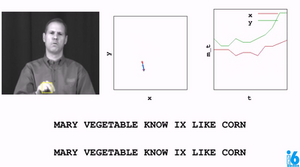
Trained a set of Hidden Markov Models to recognize words signed in American Sign Language, using a preprocessed dataset of tracked hand and nose positions provided by Udacity. HMMs are a natural fit for sequential gesture data — each sign becomes a sequence of pose observations, and the recognizer picks the model whose hidden-state trajectory best explains what it saw.
Most of the project was around model selection: trying constant, BIC, DIC, and cross-validation criteria to choose the right number of hidden states per word, then evaluating WER (word error rate) across the test sentences.